Neural Audio Synthesis as Compositional Medium for EEG Data Sonification
One night of sleep EEG, turned into sound: bandpower from each electrode
navigates the latent spaces of three RAVE neural audio models, and the
scored sleep stages decide which of those voices you hear at any moment.
Stefanos Vasilakis, Areti Andreopoulou, Thanos Polymeneas Liontiris —
ICAD 2026, the International Conference on Auditory Display.
Headphones recommended.
Listen
Three full-length pieces, each a whole night of sleep time-compressed
30:1. They run about fourteen and a half minutes; the excerpts below are
the way in if you are standing at the poster.
The full composition
complete piece
14:28
The voice and modular models, gated against each other by the scored
sleep stages: the stage decides which electrode-and-model pairings are
audible, so the texture turns over as the sleeper moves between stages.
The organ model is not part of this piece — it stands alone below.
Coming soon. The full composition will be posted here
before the conference.
Seven passages from the composition, each cut around a sustained change
of sleep stage. Stage boundaries come from the three-scorer human
consensus scoring of the night. Times in brackets are positions in the
full composition.
Sleep onset
wake → N1 → N2
0:32
The first descent out of wakefulness [0:33]. Scoring here is unstable — the sleeper crosses into N1 at 0:41 and N2 at 0:48, then surfaces again — and that instability is audible as the texture keeps resettling.
composition
voices
organ
Coming soon. This excerpt will be posted here before
the conference.
The night's longest stretch of slow-wave sleep [12:30], entered at 12:38 and broken by an arousal to wake at 13:10 — the sharpest stage change in the piece.
composition
voices
organ
Coming soon. This excerpt will be posted here before
the conference.
One complete sleep cycle end to end [4:46] — down through N2 into slow-wave sleep at 5:22, back up to N2 at 5:43, into REM at 6:19, and out again at 7:23. The longest excerpt, and the one that shows the architecture of the night rather than a single boundary.
composition
voices
organ
Coming soon. This excerpt will be posted here before
the conference.
Diagram coming soon
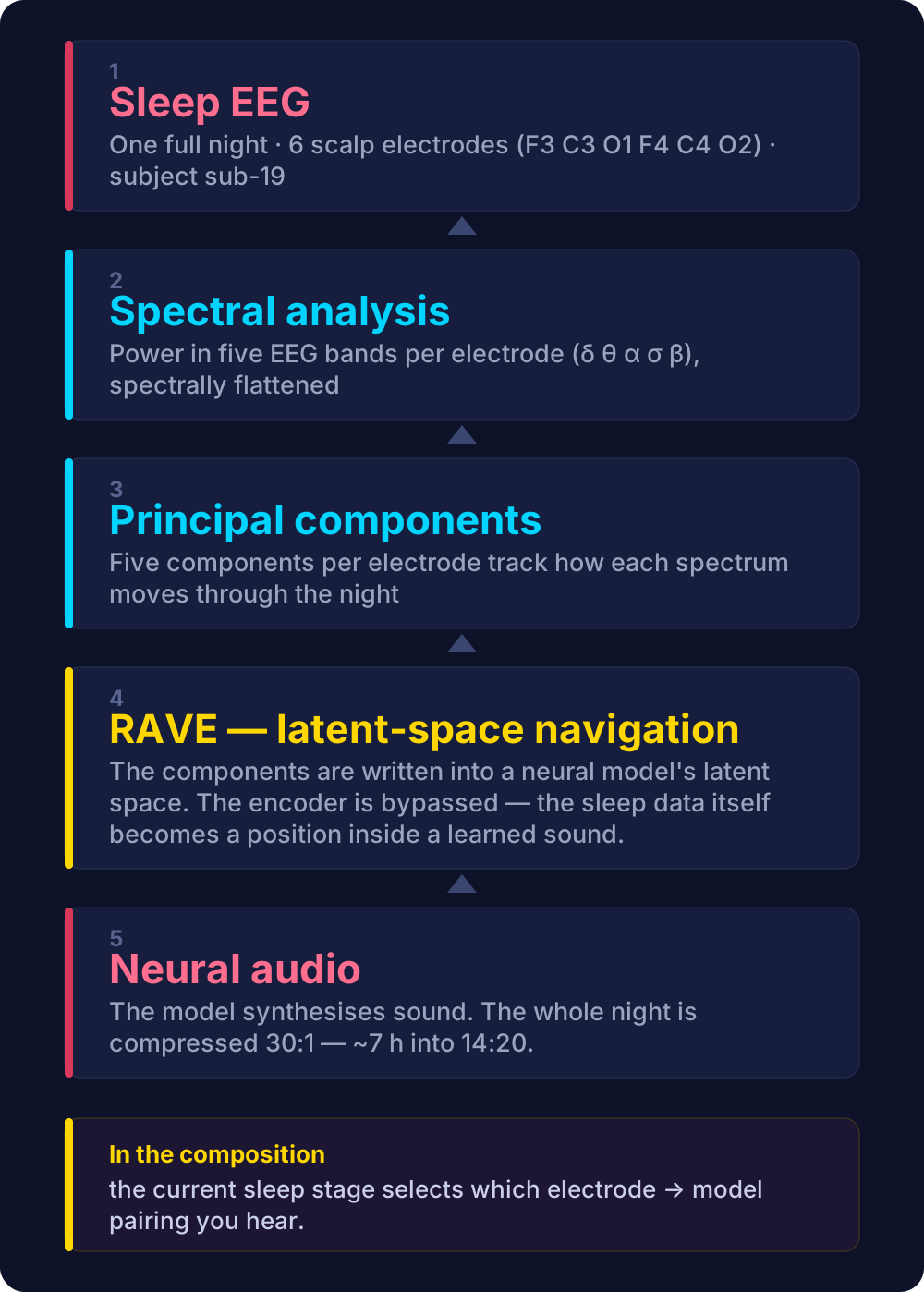
An overview of the signal path from EEG to audio.
From electrode to audio: Welch power spectral density gives five
bandpower values per 2.56-second epoch, spectral flattening lifts the
faster bands out from under the 1/f slope, and principal component
analysis per electrode reduces those to the control signals that steer
each RAVE model's latent space at roughly 23 Hz.
Which model sounds when
Which electrode–model pair sounds in each sleep stage. Left/right
electrodes are panned across the stereo field.
Electrodes & model
Wake
N1
N2
N3
REM
F3 / F4 · voice
● on
● on
● on
● on
● on
C3 / C4 · voice
● on
● on
● on
● on
● on
O1 / O2 · voice
– off
– off
– off
● on
● on
F3 / F4 · modular
– off
● on
– off
– off
– off
C3 / C4 · modular
– off
● on
● on
– off
– off
O1 / O2 · modular
– off
– off
– off
– off
● on
voice is the choir RAVE model, modular
the mixtapes model. The organ model is not gated into the composition —
it is heard only in the standalone Organ soundscape above.
About
The source recording is one night from the Bitbrain Open Access Sleep
dataset. Every sound you hear is generated unconditionally by the RAVE
models — no audio is fed into them; only the EEG-derived control
signals move through their latent spaces. Nothing is sample playback.